HELIX360
fractional-leadership
Fractional CTO for Healthcare Services: What It Actually Is (and When You Need One)
Discover what a Fractional CTO does for $10M+ healthcare services companies, when to hire one, and how they reduce incidents by 30-50% while restoring operational trust.

Chet Naran
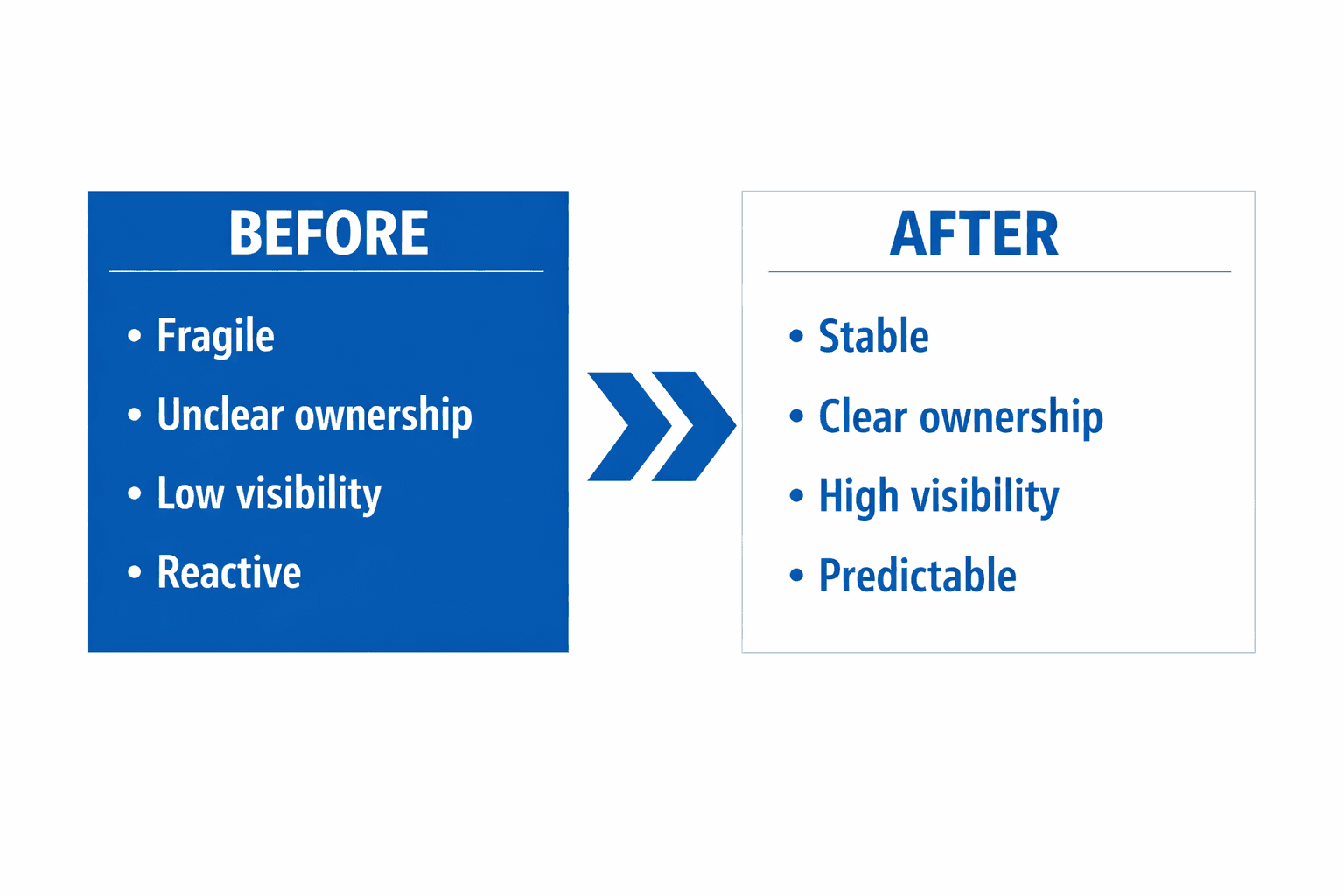
You know what’s interesting about healthcare at $10M+?
Interoperability gets all the attention. But that’s not usually where things start to feel off.
What I see more often is this: delivery still works, but it’s starting to feel fragile. Like everything’s held together by a few really smart people who know how to route around the mess.
And here’s the thing, nothing is actually broken in a way that forces you to stop and fix it. But you can feel the drag.
Incidents feel normal. Decisions take longer. Your calendar is full of “quick questions” that shouldn’t need to be questions. And if one of those key people took a vacation, you’d probably feel it.
That’s not a tech problem.
That’s an operating system problem.
And in healthcare, it has a cost. Patient experience slips. Staff gets frustrated. Billing leaks. And your attention, the thing you need for strategy, gets eaten by operations.
So what do you do?
Most people’s first instinct is to buy another platform. Add another tool. Hire another person.
But if the way work actually flows isn’t clear, more tools just make it worse.
The first move is restoring the operating conditions that let your platforms and your people work together again.
That’s what a Fractional CTO is supposed to do. When it’s done right.
What Does a Fractional CTO Do?
I’m not talking about part-time IT support or a consultant who shows up, writes a deck, and disappears.
I’m talking about embedded operating leadership. Someone who works alongside your teams, understands where the friction is, and helps you stabilize how work moves, so it doesn’t all run through you anymore.
Here’s the reality: at $10M+, growth has outpaced the systems that got you here. The workflows that used to be obvious are now invisible. Ownership is fuzzy. Handoffs break down. And nobody’s quite sure what “done” looks like anymore.
That’s not laziness. That’s scale.
And the fix isn’t a transformation. It’s clarity.
How a Fractional CTO Stabilizes Healthcare Operations
I don’t start with a roadmap. I start where the friction is already costing you.
Step one: pick one or two high-friction flows and stabilize them.
Not “fix everything.” Just the chains where exceptions pile up and people are quietly working around the system.
In healthcare services, it’s usually:
Patient intake and onboarding
Service delivery handoffs
Clinical documentation to billing
Incident response and escalations
Referral coordination
If those flows are unstable, no amount of new technology is going to feel good.
The outcome? Exceptions become visible before they become crises. And your team stops spending half their day firefighting.
Step two: make ownership explicit.
Most teams don’t have a tech problem. They have an “I don’t know whose job that is” problem.
When ownership is unclear, decisions ricochet. Tickets become therapy sessions. Projects stall at 90% complete forever.
A Fractional CTO makes ownership simple enough to use on a busy Thursday afternoon. Not a RACI chart nobody looks at. Just clarity about who owns what, how decisions get made, and what “done” actually means.
The outcome? Escalations drop by 30-50% without adding bureaucracy.
Step three: give leadership a weekly operating view they can trust.
If you can’t see work, risk, and priorities in one place, your organization defaults to meetings, Slack, and gut feel.
I help install a light operating cadence that replaces status chasing with actual decisions and follow-through.
The outcome isn’t more reporting. It’s fewer surprises and faster action.
Step four: align people, process, and platforms so the system carries the work again.
This is where it gets both technical and operational.
We reduce tool sprawl. Tighten integrations where trust breaks. Create simple governance so issues don’t bounce between teams. Protect patient-facing systems while simplifying back-office noise. And lower incident load by addressing root causes, not symptoms.
The goal isn’t modernization for its own sake.
The goal is operational trust.
When that exists, growth stops feeling like strain.
The Full Scope: Strategic, Operational, and Compliance Leadership
Here’s what people sometimes miss: a Fractional CTO with a tech-driven COO lens isn’t just fixing one process.
It’s strategic and operational leadership embedded across the business.
That means working with clinical teams, operations, HR, finance, and leadership to align technology, systems, and execution.
On the strategic side:
System selection and vendor evaluation (EHR, CRM, billing platforms, integrations)
Technical architecture and infrastructure planning
Security, HIPAA compliance, and risk management, which are built into operations, not bolted on
Roadmap clarity: what to build, what to buy, what to wait on
On the compliance and governance side:
HIPAA and regulatory compliance strategy that enables the business rather than slowing it down
Security posture, access controls, and incident response planning
Governance frameworks that clarify ownership, decision rights, and accountability
Audit readiness and documentation that protects the organization
On the operational side:
Dashboard and reporting infrastructure so leadership has visibility
Process design and workflow optimization across departments
Incident management and root cause resolution
System governance and change management
Cross-functionally:
Partnering with HR on HRIS, learning systems, and onboarding technology
Supporting finance on billing systems, data accuracy, and margin visibility
Enabling clinical teams with tools that actually support care delivery
Aligning leadership on outcomes, priorities, and execution cadence
Building capability:
Coaching internal IT or operations staff
Building vendor relationships and managing external partners
Training programs and adoption strategy
Creating documentation and playbooks that transfer knowledge
The role is both in the weeds and at the table. Working alongside your teams during the week and advising leadership on strategic decisions.
It’s not advising from a distance. It’s embedded, operational, and accountable for outcomes.
A real example
I worked with a growing healthcare services organization where provider satisfaction with the EHR was tanking.
Leadership wanted to improve adoption and confidence. But the problem wasn’t the EHR itself.
The problem was that the training program had no lifecycle.
New providers got onboarded, sure. But there was no structure for ongoing optimization. No way to benchmark performance. No clear path to support providers who were struggling.
So we redesigned it:
Built a 2-year training lifecycle (not just onboarding)
Created dashboards from utilization reports to benchmark provider productivity
Launched a Provider Mentor program so physician reps were part of training development
Restructured the training team into two specialized areas: new hire training and optimization training
The result? Provider confidence improved. EHR proficiency became measurable. And the system finally supported the humans using it, not the other way around.
That’s the pattern.
The workflow existed. But it lived in people’s heads.
Once we made it explicit, visible, and repeatable, the technology started working the way leadership expected.
What makes healthcare different
Healthcare doesn’t forgive unclear systems.
If your staff can’t trust what they’re seeing inside the workflow, they compensate.
They re-check. Re-key. Re-call. Re-confirm.
That compensation is invisible on a project plan. But it’s loud in daily operations.
It shows up as longer patient wait times. Billing delays. Staff burnout. Compliance risk nobody can quite quantify.
The cost isn’t just time.
It’s confidence.
And in healthcare, confidence is non-negotiable.
When to Hire a Fractional CTO for Your Healthcare Company
If any of these sound familiar, you’re probably in the window where fractional leadership makes sense:
Delivery depends on a few people and you can’t scale without them
Exceptions and interruptions are driving the day
Tools keep getting added but outcomes aren’t improving
You have a roadmap, but execution keeps slipping
You want tighter governance without turning the company into a bureaucracy
If you’re nodding, the next step usually isn’t a big transformation.
It’s clarity.
This is usually where leaders ask me: “Is this actually our issue, or am I overthinking it?”
If you want a quick outside mirror, the [Clarity Snapshot] is a short way to pressure-test that before talking to anyone. It’s designed as a self-check, not a sales funnel.
How to Get Started: The Systems Reset Sprint
Most teams do best starting with something short that creates relief and a clear path forward.
That’s what a [Systems Reset Sprint] is for.
It’s a focused engagement that:
Surfaces where work, data, and decisions break down first
Stabilizes one or two high-friction flows
Clarifies ownership and decision rights
Creates a 60 to 90 day plan leadership can actually run
If it turns into a longer relationship, great.
If it doesn’t, you still leave with clarity and momentum.
What changes in 60-90 days when this is done right:
30-50% fewer incidents and escalations
Faster onboarding (sometimes cut in half)
Founder dependency drops because the system carries the decisions
Leadership gets a single weekly view they can actually trust
Frequently Asked Questions
What does a fractional CTO do?
A Fractional CTO provides strategic and operational technology leadership without the full-time commitment. For $10M+ healthcare services companies, that means embedded leadership that stabilizes how work flows, clarifies ownership, aligns people and systems, and builds the operating conditions your team can trust. It's not part-time IT support, it's the person working alongside your teams during the week and advising leadership on strategic decisions.
When should I hire a fractional CTO?
You're probably ready when delivery depends on a few key people, exceptions feel normal, tools keep getting added but outcomes aren't improving, or you're tired of being the routing layer for every decision. If growth has outpaced your systems and you need operational clarity without a full transformation, that's the window.
What's the difference between a fractional CTO and a consultant?
Consultants typically show up, write a deck, and leave. A Fractional CTO embeds with your team, works in the weeds alongside your people, and is accountable for outcomes, not just recommendations. It's operating leadership, not advice from a distance. You're getting someone who owns the work and stays until it sticks.
One last thing
If your organization is held together by heroic effort, and you’re tired of being the routing layer for delivery decisions, this is what a Fractional CTO should be doing.
Not chasing shiny tech.
Not selling an implementation.
Building operating conditions your team can trust.
If you want to sanity-check whether this is your situation, let’s start with a short clarity conversation.


