HELIX360
technology
Your Tech Debt Problem Isn’t About Code: It’s About Your Operating System
Tech debt isn’t just about code. It’s a signal your operating system hasn’t kept pace with growth. Here’s how to turn chaotic ops and tools into a calmer, scalable way of working.

Chet Naran

If you’re running a founder-led, tech-enabled company that’s been growing fast, you don’t need another thought piece on “clean code” or refactoring practices.
You’re feeling something much more human:
Systems that used to work now feel fragile.
Your team is patching things at odd hours.
Every change seems to have a side effect somewhere else.
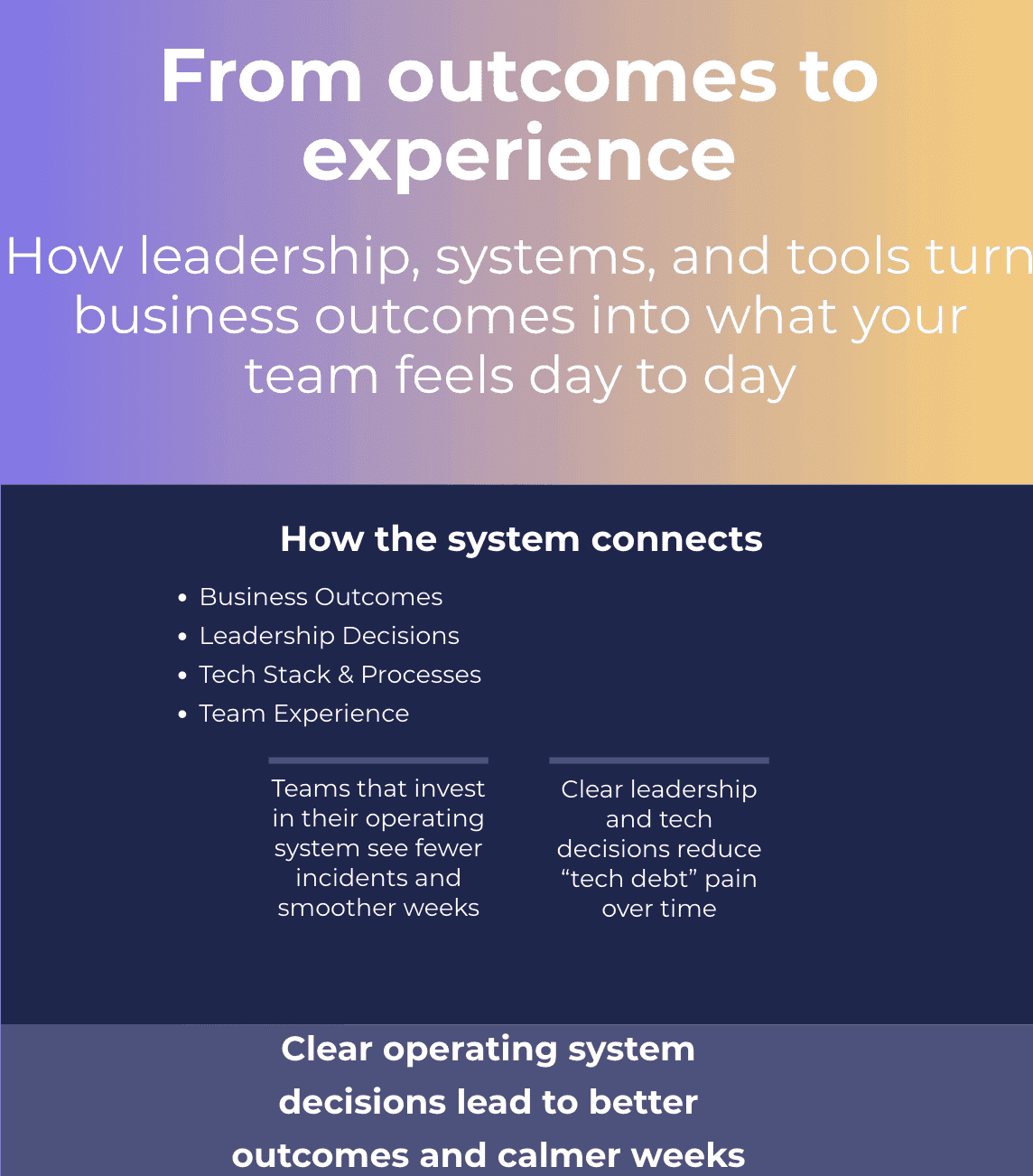
We call it tech debt, but what you’re really experiencing is this:
This isn’t about code quality, it’s about an operating system that hasn’t kept pace with your business.
Reflective question:
Where does “tech debt” actually show up in your week, in tickets, in people’s calendars, or in your own head?
Tech Debt Is the Smoke, Not the Fire
What’s happening (reality)
As a company scales, a familiar pattern shows up:
The stack grew organically around decisions that made sense at the time.
A few key people know how it all hangs together.
Every feature, integration, or new client ask feels like pulling on a loose thread.
The codebase gets blamed, but the real issue is how decisions get made and governed.
Why it matters (risk, cost, friction)
When tech debt is treated purely as a code problem:
You fund “modernization projects” that don’t change how work actually flows.
The same bottlenecks reappear after each big initiative.
The founder still gets pulled in to arbitrate tool and platform decisions.
Your team feels like they’re building on sand.
What disciplined leaders do differently
Leaders who get ahead of this:
Treat the tech stack as a living system, not a pile of tools.
Tie technical decisions to a small set of business outcomes: reliability, margin, speed, risk.
Make it clear who owns the system at the leadership level, not just in engineering.
Reflective question:
If you listed your top three business outcomes for the next 12–18 months, could your current stack actually support them without heroic effort?
Tech Debt Isn’t Just in the Backlog
What’s happening (reality)
In founder-led, tech-enabled companies, tech debt doesn’t just live in the codebase. It shows up as:
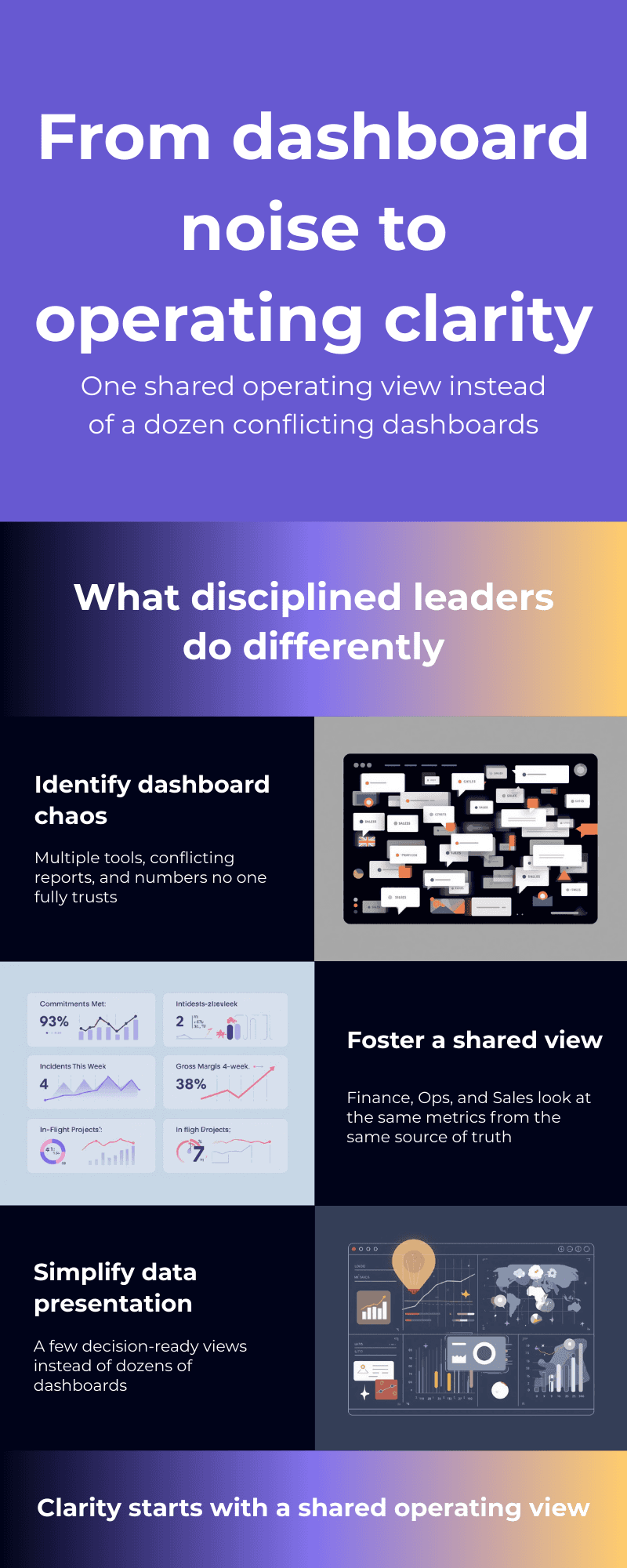
Shadow systems in spreadsheets and side tools because the “real system” is too painful.
Conflicting reports between Finance, Ops, and Sales, no one fully trusts the numbers.
Fragile integrations that everyone is afraid to touch.
Meetings where more time is spent reconciling data than making decisions.
Dashboards multiply. Confidence doesn’t.
Why it matters
When every function has its own view of reality:
Decisions slow down or get made on gut feel (again).
Teams argue about whose numbers are right instead of what to do next.
Leaders can’t see risk or margin erosion until it’s expensive.
Tech debt becomes decision debt.
What disciplined leaders do differently
The teams that get traction:
Draw a clear line and define a single source of truth for core metrics.
Simplify reporting to a few decision-ready views instead of dozens of dashboards.
Use tech debt conversations to fix information flow, not just code.
Reflective question:
If your leadership team had to make a high-stakes decision tomorrow, would everyone be looking at the same, trusted picture of the business?
Tech Debt Is Also a Leadership Load Problem
What’s happening (reality)
At your stage, tech decisions are no longer “IT choices”, they’re strategic.
But often:
The founder is still the unofficial chief systems architect, even if that’s not their title.
Internal leaders are stretched; they don’t have the space to step back and redesign how work flows.
Everyone is busy keeping the plane in the air, so no one is accountable for how the plane is actually built.
Why it matters
When leadership capacity is maxed out:
Tech debt conversations turn into blame or avoidance.
You fund projects without a clear owner for the ongoing operating rhythm.
The same people you rely on for “heroic saves” are the ones most at risk of burning out.
It’s the business version of keeping that one broken chair around, everyone avoids it, nobody fixes it.
What disciplined leaders do differently
Instead of asking existing leaders to “just also own the system,” they:
Acknowledge that operating system design is real work, not background noise.
Make space or bring in support to create bench strength without over-hiring.
Make sure there’s a named owner for the operating system, not just for projects.
Reflective question:
If you wrote down everything you actually expect your senior leaders to own, is there anyone explicitly accountable for the operating system itself?
From Tech Debt to a Calm Operating System
What’s happening (reality)
You don’t fix years of accumulated tech and process debt with a single platform swap or a heroic “transformation project.”
You need a way to:
Understand how work really moves today.
Align leaders on what “good” looks like.
Simplify flows and tools in small, safe steps.
Rebuild trust in the system.
Implement changes without overwhelming the team.
Tie it all back to revenue and risk outcomes.
This is the kind of work I care about.
In my own practice, it shows up as The Helix Method™, moving through six focused movements (Familiarize, Align, Simplify, Trust, Implement, Revenue) to gradually replace chaos with a calm operating system your people can actually run.
Why it matters
Because each movement is small enough to ship quickly and meaningful enough to compound:
You see early wins (reduced incidents, clearer ownership) without a huge reorg.
Your team experiences change as relief, not disruption.
Tech debt becomes a handled, ongoing discipline, not an ever-growing monster.
What disciplined leaders do differently
They commit not just to “fixing the stack,” but to:
Making their operating system visible.
Tuning it in small, deliberate passes.
Letting outcomes, reliability, margin, pace of delivery, be the scoreboard.
Reflective question:
If you knew you could make your operating system materially calmer in the next 90 days, what would you want to feel different first - incidents, handoffs, visibility, or leadership load?

Vendor-Positive Callout: It’s Not About the Tool Shelf
There are excellent platforms, vendors, and implementation partners out there.
This isn’t a “tools are bad” argument.
The pattern that shows up in growing, founder-led companies usually isn’t:
“You chose the wrong CRM,” or
“You should have gone all-in on one cloud,”
It’s that systems were added faster than leadership conditions were updated:
No one was clearly accountable for the operating system as a whole.
Adoption and change were treated as “we’ll figure it out” instead of designed.
Success was measured in go-live dates, not in calmer weeks or better margins.
When you put leadership, alignment, and operating rhythm first:
Good tools start performing like the investments they are.
Vendor relationships become partnerships, not recurring line items.
Tech debt conversations shift from blame to “what do we need our system to enable?”
Tech Debt as a Leadership Signal, Not a Life Sentence
If your systems feel heavier than your stage should require, you’re not alone.
Most founder-led, tech-enabled companies grow faster than their operating system.
The leaders who come out the other side with calmer weeks and stronger companies are the ones who:
Treat tech debt as a signal that leadership, alignment, and systems need attention.
Make time to redesign how work flows, not just where work lives.
Build an operating system that is strong enough to scale and human enough to trust.
No big declaration required. Just a decision: “We’re not going to keep scaling on heroics.”
Final Question
As you head into your next stage of growth, how are you making sure that “tech debt” becomes the nudge to build a calmer operating system, instead of the story your team keeps telling themselves about why things can’t change?


